Bilingual Halloween Vocabulary (35 Words for Costumes, Candy & Calabaza)
By Lindsey Carleton, MA, CCC-SLP
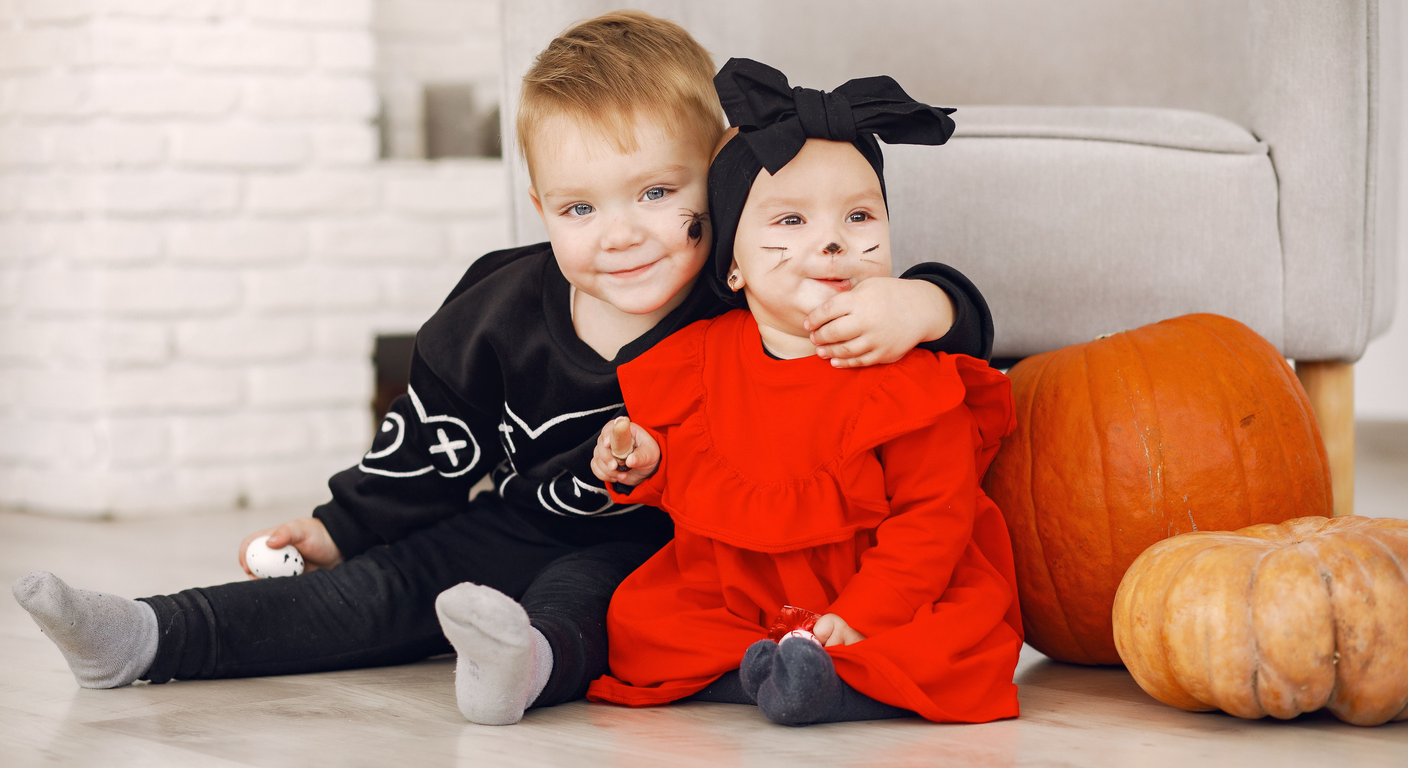
Halloween is one of those holidays where the vocabulary is fun — brujas, esqueletos, calabazas — and the toddler’s brain is wide awake because everything looks weird and exciting. October is the easiest single month to pile in seasonal Spanish vocabulary, because every word has a costume, an aisle, or a yard decoration to attach to.
Here are the 35 words, organized by what they’re for, plus four phrases you’ll actually use on October 31 night.
Costumes (12 words)
| Spanish | English | Pronunciation |
|---|---|---|
| bruja | witch | BROO-ha |
| brujo | warlock / male witch | BROO-ho |
| fantasma | ghost | fan-TAS-ma |
| esqueleto | skeleton | es-keh-LEH-to |
| vampiro | vampire | bam-PEE-ro |
| momia | mummy | MOH-mya |
| zombi | zombie | SOM-bee |
| princesa | princess | preen-SEH-sa |
| pirata | pirate | pee-RAH-ta |
| superhéroe | superhero | soo-per-EH-ro-eh |
| dinosaurio | dinosaur | dee-no-SOW-ryo |
| disfraz | costume | dees-FRAHS |
Candy and treats (8 words)
| Spanish | English | Pronunciation |
|---|---|---|
| dulces | candies / sweets | DOOL-sehs |
| chocolate | chocolate | cho-ko-LAH-teh |
| caramelo | caramel / hard candy | ka-ra-MEH-lo |
| paleta | lollipop | pa-LEH-ta |
| gomita | gummy | go-MEE-ta |
| galleta | cookie | ga-YEH-ta |
| canasta | basket | ka-NAS-ta |
| bolsa | bag | BOL-sa |
Pumpkin patch and yard (10 words)
| Spanish | English | Pronunciation |
|---|---|---|
| calabaza | pumpkin | ka-la-BAH-sa |
| telaraña | spiderweb | teh-la-RAH-nya |
| araña | spider | a-RAH-nya |
| murciélago | bat | moor-SYEH-la-go |
| gato negro | black cat | GAH-to NEH-gro |
| luna | moon | LOO-na |
| miedo | fear | MYEH-do |
| oscuro | dark | os-KOO-ro |
| linterna | flashlight / lantern | leen-TER-na |
| vela | candle | BEH-la |
Halloween actions (5 words)
| Spanish | English | Pronunciation |
|---|---|---|
| asustar | to scare | a-soos-TAR |
| reírse | to laugh | reh-EER-seh |
| correr | to run | ko-RREHR |
| pedir | to ask | peh-DEER |
| compartir | to share | com-par-TEER |
The four Halloween-night phrases
These are what you’ll actually say walking the neighborhood on October 31.
1. The trick-or-treat ask
“¡Dulce o truco!” — Trick or treat!
In some Latin American countries (especially in Mexico), the phrase is “¿Calaverita?” — literally “little skull?” — referring to the little candy skulls traditionally given out around Día de Muertos. Both phrases work and many bilingual families use them interchangeably.
2. The polite gratitude
“Gracias.” — Thanks.
Make sure your toddler says it. Even a whispered “GRAH-syas” on porch number two of the night counts.
3. The encouragement when they hesitate
“Tú puedes.” — You can do it.
The first few houses are scary. This phrase, said gently behind your child, walks them up the steps.
4. The closing of the night
“¡Qué divertido!” — How fun!
Said in the car on the way home, while reviewing the candy haul. Anchors the night in positive memory.
The four-week vocabulary rollout
You don’t need all 35 words at once. October is exactly long enough to roll them in by category.
- Week 1 (Oct 1–7): Pumpkin patch and yard (10 words). Naturally introduced on your first fall walk or visit to a patch.
- Week 2 (Oct 8–14): Costumes (12 words). As you start thinking about what your child will wear.
- Week 3 (Oct 15–21): Candy and treats (8 words). As Halloween candy hits the aisles.
- Week 4 (Oct 22–31): Actions and night-of phrases (5 words + 4 phrases). The last-week intensives.
What to do on the pumpkin patch trip
The pumpkin patch is the highest-leverage Spanish day of October. Bring the list above and use 8–10 words while you’re there. Your toddler will associate the words with the place forever.
Talking about Halloween in mixed-cultural families
In many Latino households, the line between Halloween and Día de Muertos blurs in interesting ways. Your toddler may see calaveritas (sugar skulls) at the same time they see plastic Halloween skeletons, and that’s a feature, not a bug. Both traditions honor what’s scary and what’s tender — just from different angles.
If you celebrate Día de Muertos in addition to Halloween, you’ll want to introduce the related vocabulary later in October. We have a separate post on Día de los Muertos for bilingual families coming later this month.
What to skip with toddlers under 4
A few Halloween vocabulary words I’d avoid with very young children:
- muerte / muerto (death / dead) — leave for later years
- demonio / diablo (demon / devil) — culturally complicated; skip unless your family has a tradition that uses them
- sangre (blood) — too scary for 2–3-year-olds
- Anything from horror-genre adult Halloween media — keep their Halloween vocabulary in the cute spooky register
Frequently asked questions
My toddler is afraid of Halloween costumes. Can I still use the vocabulary?
Yes, and even better — naming what frightens them in Spanish actually helps. “Esto es un disfraz. Solo un disfraz.” (“This is a costume. Just a costume.”) Putting a name on the scary thing reduces its grip. Toddlers handle fear better when they have words.
Should I let my toddler trick-or-treat in Spanish-speaking neighborhoods?
If you live in one or near one, yes. The cultural immersion of trick-or-treating at a house where someone responds “¡Hola, princesa! ¡Qué bonita!” is a vocabulary multiplier.
Are there bilingual Halloween books?
Yes. Goodnight Goon (English with Spanish translation versions exist), La Llorona / The Weeping Woman (for older kids), and Pat the Bunny en Español aren’t Halloween-specific but feel right for the season. The library carries a rotating set.
What about Halloween songs in Spanish?
A few good options: “La Bruja” by 123 Andrés (children’s musical duo), “Esqueleto” from the Caillou en Español catalog, and traditional Mexican song “Los Esqueletos” sung in many bilingual preschools. See our broader 15 Spanish songs for toddlers post for non-seasonal favorites.
My partner doesn’t speak Spanish — how do they use this vocabulary?
The same way you do — using the pronunciation hints. Toddlers benefit from hearing imperfect Spanish from both parents far more than perfect Spanish from one. See our bilingual parenting when only one parent speaks Spanish post for the broader pattern.
For sequenced seasonal vocabulary across the whole year (fall, winter, spring, summer), see the 12-month curriculum. For free, start with our Spanish phrase cards.