Spanish Drop-Off and Pick-Up — Phrases That Survive a Hectic Morning
By Lindsey Carleton, MA, CCC-SLP
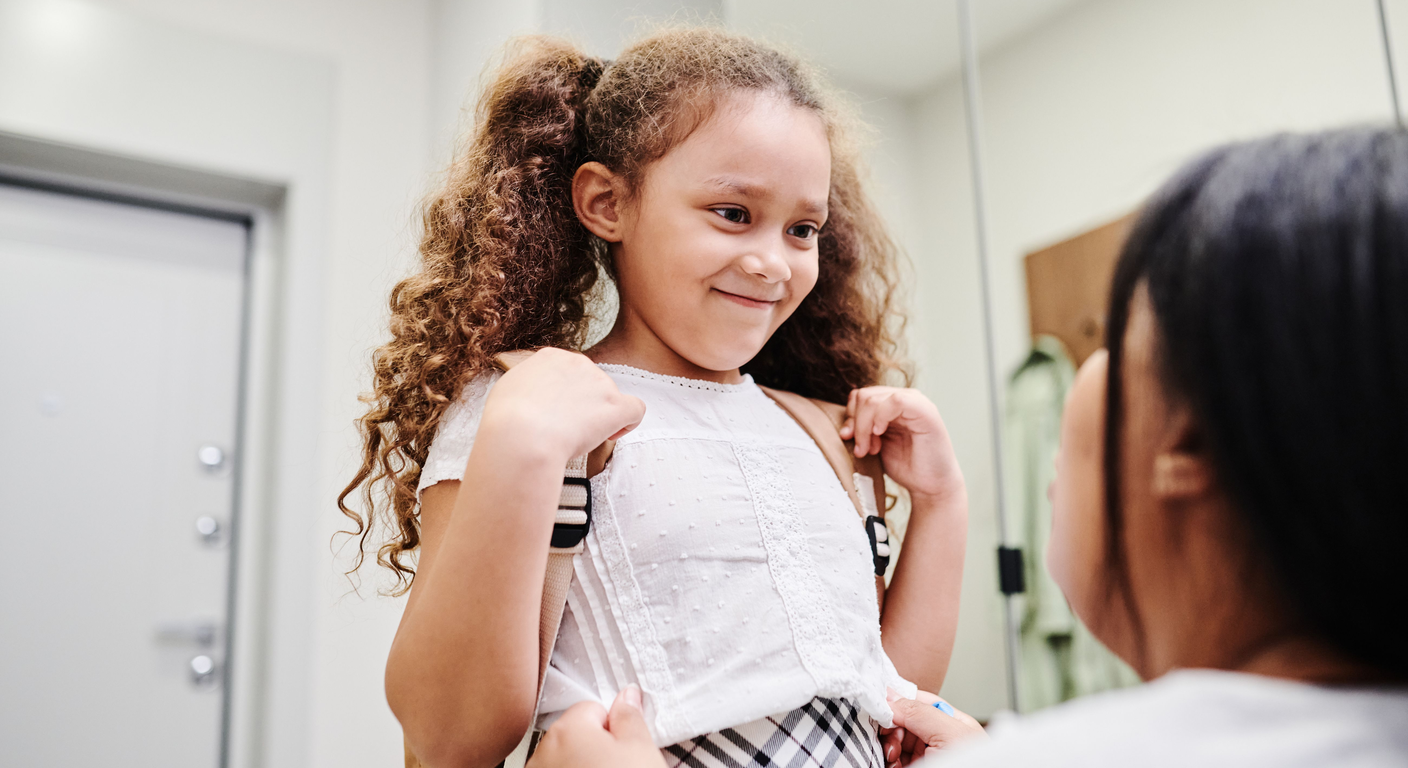
The two minutes at preschool drop-off and the four minutes at pick-up account for almost twenty Spanish minutes a week, and they happen at moments your toddler’s brain is unusually attentive — leaving you, returning to you. If you anchor a small Spanish ritual to these two transitions, the vocabulary sticks faster than almost anywhere else in the week.
The catch: mornings are chaos. You need phrases that work when you’ve spilled coffee on your shirt, the toddler refuses shoes, and you’re seven minutes behind. Here’s the set that actually survives those conditions.
The drop-off ritual (3 phrases, 30 seconds)
You don’t need a long goodbye. You need the same three phrases, said in the same order, every single day. After two weeks, your toddler will be saying them with you. After two months, they’ll say them to you.
- “Buenos días, mi amor.” — Good morning, my love.
- “Te quiero.” — I love you.
- “Hasta luego.” — See you later.
Total time: 8 seconds. Total impact over a school year of 180 days: 1,440 repetitions of three core phrases.
Don’t add to it. Don’t shorten it on rushed days. Same three phrases, same order. That’s the entire ritual.
Why this ritual works
Toddlers learn vocabulary through predictable repetition in emotionally charged contexts. Drop-off is emotionally charged. Repetition is built in. And the three phrases above cover three different language functions — greeting, affection statement, closure — so your child hears the structure of Spanish goodbyes, not just words.
For the broader why-this-works overview, see our bilingual bedtime routine post — same pedagogical principle, evening edition.
What to do if your toddler resists Spanish at drop-off
A common pattern: parent says “Buenos días, mi amor” and toddler answers “Stop saying that, Mom.” Especially common around 4–5 when peer pressure starts.
The response is not to switch to English. The response is to keep doing it, gently, and to add one validation:
“I know you don’t love it right now. I love saying it because it’s how I say good morning to you. Hasta luego.”
Don’t escalate. Don’t make it a battle. The toddler is testing whether the ritual is real. Keep it real and they’ll stop resisting within a week or two. For deeper strategies, see our when your child refuses to speak Spanish post.
The pick-up ritual (4 phrases, 60 seconds)
Pick-up is longer because your toddler usually has news. Build it around four anchor phrases:
- “Hola, mi amor.” — Hello, my love.
- “¿Cómo estás?” — How are you?
- “¿Qué hiciste hoy?” — What did you do today?
- “Vámonos.” — Let’s go.
The middle two are real conversation invitations. Your toddler will answer in English most days, especially early on. That’s fine. You asked in Spanish; they heard Spanish; their brain processed Spanish. The asymmetry — Spanish in, English out — is normal bilingual development. See our receptive vs expressive bilingualism post for the full picture of why.
What you’ll actually say on hard mornings
Here are real-life sentence completions for the worst mornings. Build these in alongside the anchor phrases. Use the ones that fit your week.
When you’re late
“¡Apúrate, mi amor! Vamos rápido.” — Hurry, my love! Let’s go fast.
“Necesitamos correr.” — We need to run.
“Vamos, vamos.” — Come on, come on.
When they don’t want their shoes / coat / backpack
“Es hora de los zapatos.” — It’s time for shoes.
“Tenemos que ir.” — We have to go.
“Por favor, ayúdame.” — Please help me.
When they’re crying at the classroom door
“Yo sé. Está bien. Te quiero.” — I know. It’s okay. I love you.
“Voy a regresar.” — I’m coming back.
“Te veo después.” — I’ll see you later.
When they tell you about their day in the car
“¿De verdad?” — Really?
“Qué bonito.” — How nice.
“Cuéntame más.” — Tell me more.
The high-leverage detail: pronounce your child’s name in Spanish
If your child has a name that exists in Spanish — Ana, Lucia, Mateo, Sofia, Diego — use the Spanish pronunciation at drop-off and pick-up specifically. “Hola, Lucia” (LOO-see-ah) lands differently than “Hi Lucia” (LOO-sha). Your child will start to associate the Spanish version of their own name with the bilingual moments of their day.
If your child’s name doesn’t exist naturally in Spanish, you can still add a soft “mi amor” or “mi vida” (my life) — endearments work as cultural anchors even for names that don’t translate.
Talking to the teacher when you arrive
Most U.S. preschool teachers don’t speak Spanish, but most are warm to seeing the ritual. A quick line:
“We’re working on Spanish at home — you might hear her say hasta luego sometimes. Thanks for being patient with it.”
That’s all you need. You’re not asking the teacher to do anything; you’re letting her know what she’ll see, so she can echo it back if she wants. For the deeper navigation of a Spanish-at-home / English-at-school setup, see our when your toddler’s teacher doesn’t speak Spanish post.
Building this into a year-long rhythm
The three drop-off phrases and four pick-up phrases above cover the daily anchor. As the school year progresses, you’ll layer in topical vocabulary in the car between school and home — Spanish for weather, for the day’s food, for the playground equipment. The drop-off ritual stays constant; everything else builds on top.
The 12-month Palabra Garden curriculum sequences seasonal drop-off and pick-up vocabulary across the school year so the ritual deepens month over month without you having to plan anything.
Frequently asked questions
My partner doesn’t speak Spanish — should they do the drop-off ritual?
Yes, especially if they do drop-off more often than you. Use the pronunciation hints. The toddler will benefit from hearing the phrases from both parents — even with imperfect accent — far more than from hearing one parent occasionally do it perfectly. See our bilingual parenting when only one parent speaks Spanish post for the broader pattern.
What if drop-off is done by a grandparent or nanny?
Brief them on the three-phrase ritual once and write it on a sticky note for the dashboard. Most caregivers will do it willingly if you make it that easy. Our grandparents guide and our finding Spanish-speaking caregivers posts cover the deeper version.
My toddler walks themselves in at 5. Do I lose this ritual?
You don’t lose it; you adapt it. Say the three phrases before they walk away. “Buenos días, mi amor. Te quiero. Hasta luego.” Then watch them go. The ritual still happens; the location just shifts to the sidewalk.
Can I do this ritual in another language (Italian, Mandarin, French)?
Yes. The pedagogy is language-agnostic. Pick three phrases — greeting, affection, closure — in your target language and use them in the same order every day. The pattern is what matters.
How long until I’ll hear my toddler use these spontaneously?
About 4–6 weeks of daily use. The first phrase to come back is usually “hasta luego” because it’s the easiest one to say back without much pressure. “Te quiero” often comes next, frequently at bedtime first, then drop-off.
Hi, I’m Lindsey Carleton, MA, CCC-SLP, a bilingual speech-language pathologist with more than 11 years of experience and a fellow toddler mom. I created Palabra Garden to support families who want intentional, play-based learning at home.
The 12-month curriculum sequences drop-off, pick-up, and the in-between rhythms across a full school year. For free, start with our Spanish phrase cards for the kitchen and the car.